

What Is Omnichannel Messaging? Definition, Use Cases & vs Multichannel
Updated: Jun 8
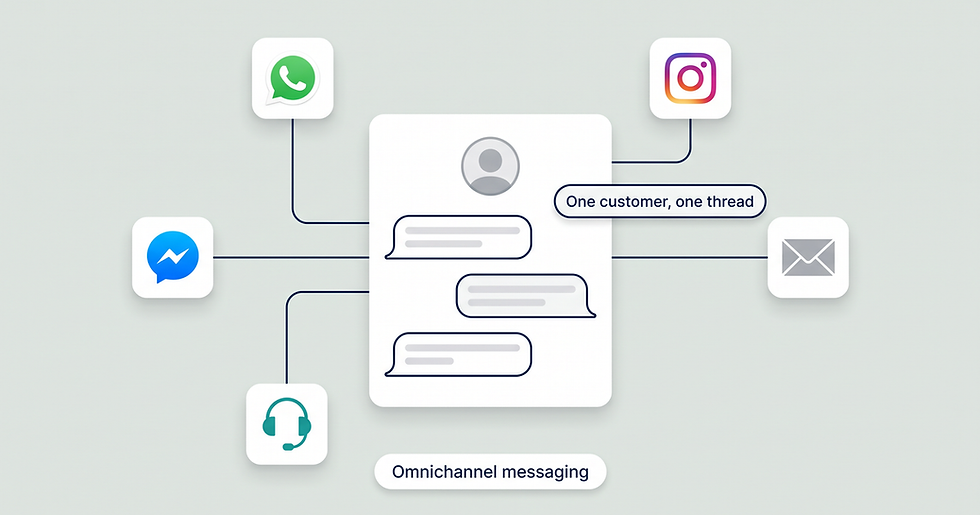
Omnichannel messaging unifies WhatsApp, Instagram DM, Facebook Messenger, SMS, email, and live web chat into one shared customer conversation history. A customer can switch from Instagram to WhatsApp mid-issue and the agent still sees the full thread. Multichannel, by contrast, runs each channel as a silo. For any business that uses the WhatsApp Business API, this distinction also matters technically — Meta's 24-hour customer-service window and approved-template rules only pay off when an omnichannel messaging platform routes replies into one conversation, not three.
What Omnichannel Messaging Means in Practice

Omnichannel messaging rests on three pillars: a unified inbox, a shared customer profile, and cross-channel context that follows the customer wherever they switch.
A customer DMs you on Instagram about an order. Two days later, they message your WhatsApp Business number to follow up. With omnichannel messaging, your support agent sees the full thread immediately, regardless of which channel the customer used. Without it, the agent asks the customer to repeat themselves — and forcing customers to repeat their context across channels is one of the most reliable ways to lose them.
Omnichannel messaging is built on three pillars:
Unified inbox — every channel surfaces in one tool, not separate apps.
Shared customer profile — phone, email, social handles, order history, tags all linked to one record.
Cross-channel context — conversations preserve history when a customer switches channels.
When all three are in place, the customer feels like they are talking to one company instead of one channel.
Omnichannel vs Multichannel: The Real Difference
Multichannel = your business uses multiple channels.
Omnichannel = those channels share data and context.
Both are valid strategies. Omnichannel is the more demanding one to set up — it carries a real platform-tier and configuration premium because of identity matching, cross-channel routing, and customer-level reporting that multichannel skips. Exact cost differs by vendor and seat count; price a like-for-like quote before deciding. Here is the side-by-side:
Dimension | Multichannel | Omnichannel |
|---|---|---|
Channel count | 2+ | 2+ |
Inbox | Separate per channel | Single unified |
Customer record | Duplicated per channel | One unified profile |
Conversation history | Per-channel only | Cross-channel |
Agent handoff | Manual context transfer | Full thread visible |
Routing rules | Per-channel | Cross-channel + customer-aware |
Reporting | Per-channel KPIs | Customer-level KPIs |
Cost & complexity | Lower | Higher (platform-tier + config premium) |
Best for | Small teams, low ticket volume | Mid-market+, retention-focused |
If a customer never crosses channels, multichannel is enough. The moment one customer touches two channels, omnichannel pays off.
Five Use Cases Where Omnichannel Messaging Wins
E-commerce: Pre-purchase to Post-purchase Continuity
A shopper asks about size guidance via Instagram DM, then 24 hours later messages WhatsApp asking about delivery on the order they just placed. Same person, two channels, one conversation. Omnichannel surfaces both threads to the agent so they can confirm size matches the order and quote a delivery window — without asking the customer to send order numbers twice.
There's also a technical reason this matters on WhatsApp Business API: if the post-purchase follow-up falls outside Meta's 24-hour customer-service window, the platform must auto-switch to a Meta-approved utility template (e.g., order_update) instead of a free-form message. An omnichannel platform handles that switch automatically; a stack of separate apps does not.
SaaS Onboarding: Trial-to-Paid Handoff
A new trial signup chats with sales on the website live web chat about pricing. Two days later they DM the company's social media account asking how to enable a feature. Omnichannel messaging links both interactions to the same trial account, so the agent sees the prior pricing concern and can address it in the same reply that solves the feature question.
Finance and KYC: Document Collection Across Channels
Compliance often requires customers to send identification photos. Customers prefer to use whichever channel is convenient — sometimes WhatsApp, sometimes email — where local KYC rules permit WhatsApp as a submission channel (regulators in some markets restrict this; check before enabling). Also check Meta's commerce and financial-services policy: certain regulated categories (e.g., unlicensed lending, crypto) are restricted on WhatsApp Business regardless of local KYC rules. With omnichannel messaging, all submitted documents land in one customer record, and an agent can verify completeness without searching three inboxes.
Healthcare: Reminders, Reschedules, and Follow-ups
Appointment reminders go out as Meta-approved utility templates over WhatsApp (or as fallback SMS). Reschedule replies arrive in the same WhatsApp thread within the 24-hour service window, so an agent can respond with a free-form message. Lab result questions that arrive later via email still attach to the same patient profile. Omnichannel routing groups all of this under one patient record so a clinic operator sees the full picture during the next reschedule call.
US healthcare note: WhatsApp Business API is not HIPAA-covered by Meta out of the box. For PHI-bearing messages, work only with a BSP that signs a BAA, or limit WhatsApp traffic to non-PHI logistics (appointment time, location, reminder) and route clinical detail through HIPAA-compliant channels.
Education: Enrollment to Course Support
Prospective students research on the website, ask preliminary questions on Facebook Messenger, get offers via SMS, and then once enrolled, ask homework questions via WhatsApp. Omnichannel messaging keeps the entire journey visible to admissions, registrar, and instructor staff in one history.
Required Platform Features

A platform only earns the omnichannel label when it ships all six: native channel integrations, a single thread per customer, automatic identity matching, cross-channel routing with 24-hour SLA awareness, template category management, and customer-level reporting.
A platform that calls itself omnichannel should support, at minimum:
Native channel integrations for WhatsApp Business API (Cloud API preferred), Instagram, Facebook Messenger, SMS, email, and live web chat. A platform that bridges channels via screen-scraping or unofficial APIs will break or get accounts banned.
Single conversation thread per customer that merges all channels.
Automatic identity matching — if a customer's phone number appears in WhatsApp and SMS, both threads attach to one record.
Tag-based segmentation that follows the customer across channels.
Cross-channel routing with SLA timers that respect WhatsApp's 24-hour customer-service window — so a reply landing at hour 25 auto-switches to a template send.
WhatsApp template management with Meta category awareness (utility / marketing / authentication / service) so cost-per-conversation or per-message (depending on category and country, as Meta migrates billing in 2025–2026) is visible before send, and the right template fires for the right intent.
Bulk broadcasts with channel-specific templates (so a WhatsApp template is approved by Meta before sending to a list).
Reporting that rolls up by customer, not by channel.
Team collaboration features — assign, mention, internal notes — visible across channels.
Tools without bulk broadcast or template category management are positioned for small teams. Tools with all of the above are positioned for mid-market and up.
How ChatBooster Fits

ChatBooster unifies WhatsApp, Instagram, Messenger, live chat — plus Threads and TikTok where available — into one workspace, auto-merging the customer profile so an Instagram inquiry and a WhatsApp follow-up are one conversation.
ChatBooster is built for omnichannel messaging across WhatsApp Business API (Meta Cloud API), Instagram, Facebook Messenger, Threads, TikTok, and website live chat. As of 2026, few rivals in the SMB price band ship native Threads and TikTok DM integrations — useful if your audience leans Gen Z or you run creator-driven campaigns. See our WhatsApp Business API explainer for the underlying mechanics.
Customer profiles unify automatically when phone or social identity matches, and the unified inbox lets sales and support teams reply without switching apps. The platform includes a no-code automation flow builder so businesses can route conversations across channels based on tags, behavior, or lifecycle stage — for example, sending an SMS reminder to a customer whose Instagram inquiry has been idle for 24 hours, or auto-firing a utility template when the WhatsApp service window closes.
When Multichannel Is Still the Right Choice
Don't over-engineer. Multichannel is fine when:
You only field a few support tickets per week and one person handles them all.
Your channels are completely separate audiences (e.g., LinkedIn for B2B, TikTok for B2C).
Channel switching is rare among your customer base (often true for very young brands).
Move to omnichannel when:
The same customer regularly contacts you on more than one channel.
Repeat-buyer rate is a key business metric.
Support volume exceeds what one person can context-switch across in a day.
You are running marketing campaigns that follow customers across channels.
Frequently Asked Questions
What is the difference between omnichannel and multichannel messaging?
Multichannel means a business uses multiple channels. Omnichannel means those channels share data, customer identity, and conversation history. With omnichannel, an agent who picks up a WhatsApp chat sees the customer's prior Instagram DM. With multichannel, the agent sees only what is in the WhatsApp app.
Is omnichannel messaging just a unified inbox?
A unified inbox is one component. True omnichannel also requires a single customer profile that links across channels, cross-channel routing rules, SLA timers that respect WhatsApp's 24-hour window, and customer-level (not channel-level) reporting.
Do I need omnichannel messaging for a small business?
Not always. If you receive fewer than 50 conversations per week and one person handles all of them, multichannel is fine. Move to omnichannel when customers regularly switch channels mid-issue or you have multiple agents needing shared context.
What channels are usually included in omnichannel messaging?
WhatsApp via the Business API (Cloud API has been Meta's standard since 2025; On-Premises API is sunset), Instagram DM, Facebook Messenger, SMS, email, and website live chat are the common six. Larger setups add Threads, TikTok DMs, Telegram, X/Twitter DMs, and voice.
How is omnichannel different from CRM?
A CRM stores customer data and history. An omnichannel messaging platform handles real-time conversations and feeds the CRM. Most omnichannel platforms ship a lightweight contact record and push events to Salesforce, HubSpot, or Zoho via native connectors or webhook.
What is the cost of omnichannel messaging software?
Pricing usually scales with active conversations, channels enabled, and team size. Entry plans in this category generally start in the low double-digits USD per month for small teams; mid-market tiers land in the low hundreds. WhatsApp Business API charges are billed per conversation (and, in selected markets and template categories from 2025, per message) on top of the platform fee, with rates that vary by country and template category. See Meta's WhatsApp Business pricing page for current rates.
Key Takeaways
Omnichannel messaging unifies channels, customer profiles, and conversation history. Multichannel only uses multiple channels.
The customer experience benefit is no repeated information across channels and faster issue resolution.
True omnichannel requires native channel integrations, single customer profiles, cross-channel routing with WhatsApp 24-hour-window awareness, template category management, and customer-level reporting.
Five common winning use cases: e-commerce continuity, SaaS onboarding, finance document collection, healthcare follow-up, and education enrollment.
Move from multichannel to omnichannel when channel-switching is regular or your support volume needs shared context across agents.
Rule of thumb: under ~50 conversations per week handled by one person → multichannel is fine; above that, or with multiple agents → omnichannel.
Try ChatBooster free to centralize WhatsApp, Instagram, Facebook Messenger, Threads, and TikTok in one omnichannel inbox. No credit card. WhatsApp Business API setup in under a day.


Comments